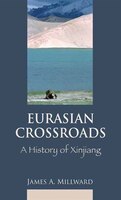
Forming one-sixth of the People''s Republic of China (PRC), Xinjiang stands at the crossroads between China, India, the Mediterranean, and Russia and has, since the Bronze Age, played a pivotal role in the social, cultural, and political developm..
Forming one-sixth of the People''s Republic of China (PRC), Xinjiang stands at the crossroads between China, India, the Mediterranean, and Russia and has, since the Bronze Age, played a pivotal role in the social, cultural, and political developm..
Xinjiang, the nominally autonomous region in China''s far northwest, is of increasing international strategic and economic importance. With a population which is mainly non-Chinese and Muslim, there are powerful forces for autonomy, and independence, in Xi..
Eastern Turkestan, now known as Xinjiang or the New Territory, makes up a sixth of China's land mass. Absorbed by the Qing in the 1880s and reconquered by Mao in 1949, this Turkic-Muslim region of China's remote northwest borders on formerly Soviet Central..
Absorbed by the Qing in the 1880s and reconquered by Mao in 1949, this Turkic-Muslim region of China's remote northwest borders on formerly Soviet Central Asia, Afghanistan, Kashmir, Mongolia, and Tibet, Will Xinjiang participate in twenty-first century as..
Absorbed by the Qing in the 1880s and reconquered by Mao in 1949, this Turkic-Muslim region of China''s remote northwest borders on formerly Soviet Central Asia, Afghanistan, Kashmir, Mongolia, and Tibet. Will Xinjiang participate in China'&..
On the Silk Road, a region of overlapping cultures, the province was virtually independent until the late nineteenth century, nominally part of the Qing Empire, with considerable interest taken in it by the British and the Russians as part of their Great G..
China''s minorities, however, have only recently begun to move in significant numbers, motivated by economic, social, and political factors. This book looks at how current changes in China are affecting the minority populations. It gives special ..